
How to Calculate the Right Stage Size For Your Event
If you are in charge of planning a dinner, a school event, a wedding solemnisation, a product launch, or a community event, the stage is often the centrepiece of your entire setup. Get the size correct, and the event flows without any issues — people on stage have space to move and your audience enjoys a clear, unobstructed view. Get it wrong, and you risk an overcrowded platform, a stage that looks out of place in the venue and you spend more for a redelivery to increase the stage size.
We have helped hundreds figure out exactly what they need. In this guide, we walk you through everything you need to consider when calculating the right stage size for your event — from understanding how our modular stage system works, to accounting for every item that will be placed on it, to choosing the right height for your occasion.
1. Understand How Our Stage System Works
Before you can calculate a stage size, it helps to understand what you are working with. Our modular stage system is built on modular individual boards measuring 4 feet by 4 feet (approximately 1.2m x 1.2m). These boards connect together. Allowing you to create a stage of virtually any size or shape to suit your event and venue.
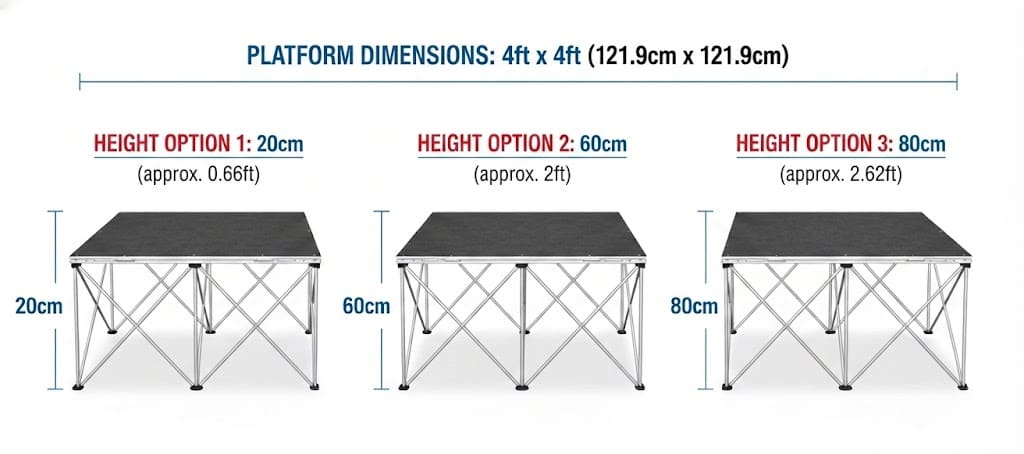
Each stage board can be set at one of three standard heights:
- 20cm — Low profile, ideal for floor-level presentations and intimate settings
- 60cm — The most popular all-rounder height, suitable for most events
- 80cm — Elevated for larger crowds or outdoor events where visibility is key
Because the boards are modular, your stage footprint is always a multiple of 4ft. Common configurations include 8ft x 8ft (4 boards), 12ft x 8ft (6 boards), 16ft x 8ft (8 boards), 20ft x 12ft (15 boards), and so on. When speaking with our team, you can describe your requirements and we will advise you accordingly.
always plan in multiples of 4ft when estimating your stage size. A 10ft x 10ft stage, for example, cannot be achieved cleanly with 4ft boards — you would need to round up to 12ft x 12ft or round down accordingly. Building your measurements around the module size from the start saves time and avoids confusion during setup.
2. Account for Everything That Will Be Placed on the Stage
The stage is rarely just for one speaker standing. Even if so, it is important to make sure the stage looks spacious and provides the speaker with space so it doesn’t look too small. Before you decide on a size, make a comprehensive list of everything — and everyone that will occupy the stage at any time.
People and Performers
Count the maximum number of people who will be on stage at any given point. For a wedding solemnisation, this could include the couple, an MC, family members, and a flower girl — that is already 8-10 people. For a corporate awards ceremony, you might have an emcee, a presenter, and multiple award recipients stepping up together for photos and to receive prizes. For a school concert or dance recital, you could be looking at multiple performers on stage at once. Take into account how each person will move and you can even mark it on the ground and measure how much space you might need for the entire group.
Furniture and Equipment
Any furniture or equipment placed on the stage reduces usable spac. Common items include:
- A rostrum for speeches (typically 60cm x 60cm footprint)
- PA system speakers, which may be placed at the front corners of the stage
- A projector screen or backdrop frame behind the main performance area
- Musical instruments such as keyboards, drum kits, or guitar amplifiers
- A DJ console or mixing board for live events and parties
- Decorative elements such as floral arrangements, a wedding arch, or a backdrop stand
Movement and Choreography Space
If your guests are dancing, doing martial arts demonstrations, or that involves movement across the stage, you need to factor in the full range of motion. A static performer needs less space than a moving one. When in doubt, add at least one extra row of boards (4ft) in each dimension to give performers a comfortable buffer from the edges. Falling off a stage or feeling cramped mid-performance is something no event planner wants to deal with.
Access and Egress
Your stage calculation should also include how people get on and off. Stairs are usually placed off to the side or at the rear of the stage and may extend beyond the main platform. If your event involves elderly guests, you may need a wider or longer staircase, which in turn affects the overall stage layout.
How Many Sets of Stairs Do You Need?
As a general rule of thumb, one set of stairs is the minimum for any stage setup. However, the number of stair sets you need scales with the size of your event, the number of people moving on and off the stage, and the flow of your event:
- 1 set of stairs — Suitable for small events where the stage is accessed by a handful of people (e.g. a single emcee or speaker). Traffic on and off the stage is minimal and infrequent, so one access point is sufficient. You can place the stairs in the middle of the stage so it does not look off balanced.
- 2 sets of stairs — The most common configuration for medium to large events. Placing one set on each side of the stage (left and right) allows for smooth, two-directional flow. This is especially useful for award ceremonies where recipients walk up from one side and exit the other, or for performances where people need to enter and exit simultaneously.
- 3 or more sets of stairs — Recommended for large-scale events with very high stage traffic, such as ceremonies,concert. Additional stair sets can be placed at the front centre of the stage or at the rear for backstage access. Front-facing stairs are particularly useful when large groups need to assemble on stage together (e.g. a school choir or a group photo).

2 sets of stairs
Additional Stair Considerations
Besides the number of stair sets, think about placement. Stairs positioned at the sides keep the front of the stage clear, which is ideal for photo and videos. If your guest-of-honour or VIPs will be ascending the stage, ensure the stair set they use is directly accessible from where they are seated. For events with elderly guests. position stairs at a convenient position.
3. Choose the Right Stage Height for Your Event Type
Stage height is often an afterthought, but it has a significant impact on how your event looks and feels. The right height improves audience sightlines, creates a sense of occasion, and ensures safety. Here is a breakdown of when to use each height:
20cm — Low Profile and Intimate
A 20cm stage is essentially a raised floor platform. It is best suited for small, intimate gatherings where the speaker or performer needs to be slightly elevated for visual separation from the crowd, but a dramatic height difference is not necessary. Examples include VIP cocktail events, small boardroom presentations, indoor seminars with a seated audience, or photo booths and display platforms. At this height, there is minimal fall risk, making it a good choice where very young children or elderly guests may be on the platform. For this height. No stairs are required.

20cm high stage for townhall meeting
60cm — The All-Rounder
The 60cm height is our most popular option and suits the widest range of events. This elevation provides excellent visibility for a seated audience of up to 300 to 400 people. It is the go-to choice for most event types. The 60cm stage strikes the right balance. Stairs at this height are comfortable and easy to navigate.
80cm — Maximum Visibility for Larger Crowds
The 80cm height is designed for events with larger audiences, outdoor settings, or situations where the stage must be visible from a greater distance. Think Concert performances, large outdoor carnivals, National Day celebrations, and community funfairs where the crowd stretches all the way back. At this height, even guests seated towards the back of the venue will have a clear view of the stage.

4. A Practical Sizing Formula to Get You Started
Not sure where to begin? Here is a simple starting framework you can use before contacting us for a detailed quote:
- Small events (under 100 guests, 1–3 people on stage): Start with an 8ft x 8ft or 8ft x 12ft stage at 60cm height
- Medium events (100–300 guests, 4–10 people on stage): Consider a 12ft x 16ft or 16ft x 16ft stage at 60cm or 80cm
- Large events (300+ guests, large cast or band): Plan for a 20ft x 16ft or larger at 80cm, with side stairs on both ends
These are starting points — your actual needs will depend on your specific programme, venue dimensions, and layout. Our experienced team at Tentage Rental Singapore is happy to walk through your event brief with you and recommend the right configuration.
Get It Right the First Time
Choosing the right stage size is one of those decisions that is easy to overlook during event planning but very difficult to fix on the day itself. Taking the time to properly calculate your requirements will make all the difference and prevent you from making last minute changes which will cost more to increase the stage size.
With over 15 years of experience in tentage and equipment rental across Singapore, our team has helped plan stages for events of every size and type. Because of our large range of equipments. We can also settle other aspects of your event as well. Whether be it tables for the stage, Rostrums for speeches, PA system to project your voice to the audience, or even cooling systems such as air coolers and fans to keep your guest cool.
Call us today to get an non obligatory quote.
